AP OBLIQUE LUMBAR
Oblique Lumbar Spine Projection • Evaluation of interapophyseal joints
Exposure Factors
Parameters similar to AP lumbar: Required to penetrate muscle mass and visualize joints
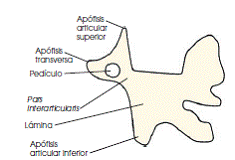
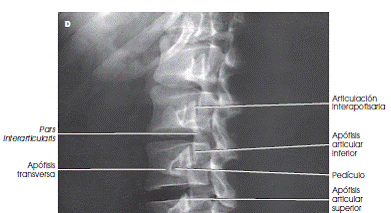
"Scottie Dog" Sign
"When the patient has been properly positioned, the images of the lumbar vertebrae will have the appearance of the Scottie dog"
Dog's Head
Superior articular process
Scottie dog's ear
Dog's Neck
Isthmus (pars interarticularis)
Scottie dog's neck
Dog's Body
Vertebral lamina
Scottie dog's body
Front Legs
Inferior articular process
Dog's front legs
Rear Legs
Superior articular inferior process
Dog's rear legs
Dog's Eye
Vertebral pedicle
Scottie dog's eye
The "Scottie dog" is a characteristic radiological sign confirming correct oblique positioning
Visible Anatomical Structure
The resulting image provides:
- Oblique projection of lumbar spine and/or lumbosacral region
- Articular processes of the side closer to IR
- Interapophyseal joints (facet joints)
- Vertebral isthmus (pars interarticularis)
- Pedicles in oblique view
- Vertebral laminae
Bilateral comparison: "Both sides are examined for comparison" to evaluate symmetry and unilateral pathology
Plate Size
Orientation: Longitudinal
Justification: Sufficient to cover entire lumbar spine in oblique projection
Rotation Angle
Note: "An oblique body position of up to 60° relative to the plane of the IR may be required to demonstrate the interapophyseal joint and articular processes of L5-S1"
Patient Positioning
Body Rotation
CENTRAL RAY - 5TH JOINT
Entry: 5 cm medial to elevated ASIS, then through midpoint between iliac crest and elevated ASIS
Purpose: Specific visualization of L5-S1 joint
Final centering: "Center IR over the central ray"
Optimal Image Characteristics
Scottie Dog
Characteristic sign visible
Joints
Clear interapophyseal
Isthmus
Defined pars interarticularis
Symmetry
Bilateral comparison possible
Overlaps
Joints without overlap
L5-S1
Joint visible with 60°
Common Technical Challenges
Common problems in oblique lumbar projection:
- Insufficient rotation (less than 45°) not clearly showing joints
- Incomplete Scottie dog or poorly defined
- Structure overlap from excessive rotation
- Patient movement due to lack of adequate supports
- L5-S1 not visible with standard 45° rotation (needs 60°)
- Asymmetry in bilateral comparison from inconsistent positioning
- Incorrect centering according to region to visualize
Solution: Verify exact rotation (45° standard, 60° for L5-S1), use supports, look for "Scottie dog" sign
Special Considerations
Acute Pain
Rotation may be painful. Consider prior analgesia or alternative technique.
Spondylolisthesis
Technique of choice for evaluating isthmus defects (spondylolysis).
Bilateral Comparison
Perform both sides with exactly the same rotation for valid comparison.
Obese Patients
Greater difficulty for rotation. May require higher kV/mAs.
Patient Instructions
"Do not breathe during exposure"
Complete sequence:
1. "Lie on your back"
2. "Turn to your [left/right] side"
3. "Maintain position with help of supports"
4. "Place arms comfortably"
5. "Take a deep breath and then exhale completely"
6. "Hold your breath and do not move"
7. "We will repeat on the other side for comparison"